Researchers develop targeted approach to kill antibiotic-resistant gonorrhoea
The study, published in PNAS, describes a novel antibody-drug conjugate (ADC) that successfully eliminated a multidrug-resistant strain of N. gonorrhoeae in laboratory tests. Researchers say the approach could offer a new direction for tackling drug-resistant bacterial infections, although further research is needed before it can be tested in people.
Gonorrhoea is the second most common bacterial sexually transmitted infection (STI) in the UK. In recent years, health experts have reported an increase of in antimicrobial resistance in gonorrhoea, reducing the number of effective treatment options available.
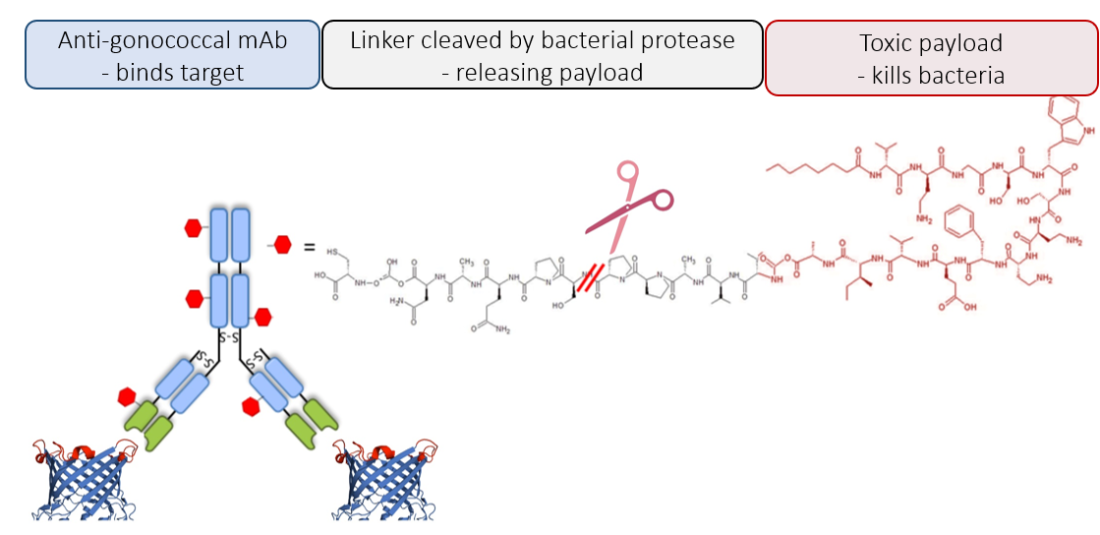
The team developed a targeted delivery system that combines an antibody, a specially designed molecular linker and a potent antimicrobial peptide. The antibody guides the treatment directly to N. gonorrhoeae, while the antimicrobial component remains inactive until it reaches the bacterium.
Uniquely, the therapy harnesses one of the pathogen’s own enzymes, known as an IgA protease, to activate the treatment. Once the antibody attaches to the bacterial surface, the enzyme cuts the linker and releases the antimicrobial peptide directly where it is needed.
Dr Hayley Lavender, former Dunn School postdoc and now a Lecturer in Microbial Pathogenesis at the University of Liverpool said: “Antibiotic-resistant gonorrhoea is an urgent and growing public health challenge. We wanted to develop a way of delivering a powerful antimicrobial agent specifically to the bacteria while reducing the risk of harming human cells.
“By exploiting an enzyme that N. gonorrhoeae normally uses to evade the immune system, we’ve shown it is possible to trigger the release of an antimicrobial payload directly at the bacterial surface.”
In laboratory experiments, the targeted therapy killed a multidrug-resistant gonococcal strain that is resistant to current first-line antibiotics. The researchers also found that attaching the antimicrobial peptide to the antibody greatly reduced toxicity in the human cell types tested, while maintaining antibacterial activity.
The findings suggest that antibody-drug conjugates, which are already widely used in cancer treatment, could potentially be adapted to tackle bacterial infections. The researchers say the modular nature of the platform means it may eventually be possible to redesign the system to target other antibiotic-resistant bacteria that produce similar enzymes.
However, the authors caution that the work remains at an early stage. The therapy has not been tested in humans, and further preclinical studies are required to assess its safety, effectiveness and delivery. Additional research will also be needed to understand whether bacteria could eventually evolve resistance to the approach.
Christoph Tang, Professor of Cellular Pathology at the Dunn School added: “While these results are encouraging, this research is still in the preclinical phase. The next steps will involve further optimisation of the technology and detailed studies to evaluate safety and efficacy before any consideration of clinical testing.”
The researchers believe the study demonstrates a fundamentally different strategy from conventional antibiotics, one that exploits bacterial biology to achieve highly targeted drug activation and may help address the growing challenge of antimicrobial resistance.
Read the paper here: An antibody–drug conjugate active against antibiotic-resistant Neisseria gonorrhoeae, PNAS,123 (31) e2534217123
Read the Paper
Hayley Lavender, Vincent Oliver , Daniel Lucy, Timothy A. Barendt, Ann E. Jerse, and Christoph M. Tang (2026) An antibody–drug conjugate active against antibiotic-resistant Neisseria gonorrhoeae, PNAS,123 (31) e2534217123
Tang lab
Understanding how pathogens colonise specific niches in the body, evade elimination by the immune system, and cause disease
Infection and Immunity
Several Dunn School groups use a range of approaches to investigate antigen presentation and immune regulation during health and disease and study the mechanisms that enable bacterial and viral pathogens to invade and proliferate inside their hosts.