Protection for newborns: new treatment to prevent meningitis
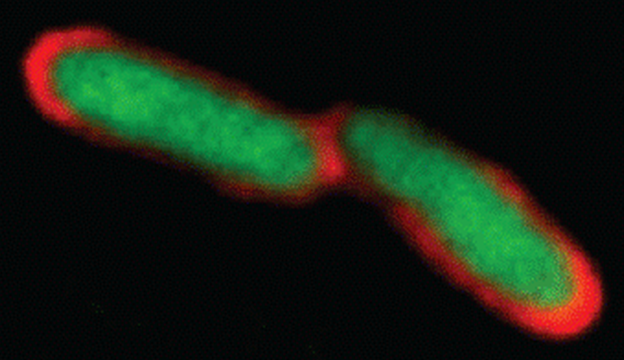
GFP-expressing bacteria (green) coated with O-antigen-binding IgA (red) Image credit – Alyson Hockenberry, ETH Zürich
Newborn meningitis is one of the most dangerous childhood infections. It is often life-threatening and can cause serious and lasting damage, including developmental problems, in the children who survive. Although meningitis is rare in newborns, it is more common in premature babies, affecting one in every 500 such infants in industrialised economies and likely more in developing countries.
One of the leading pathogens responsible for these meningitis cases is the K1 form of the E. coli bacterium. Now, the Slack group (based at the University of Oxford and ETH Zurich), in collaboration with Médéric Diard (Biozentrum, University of Basel), have developed an approach that seeks to prevent transmission to newborns.
E.coli K1 is part of the intestinal flora in one in three healthy adults, with no normal adverse effects. This is a consequence of both interactions with other bacteria and a functioning immune system. However, if the pathogen is carried by an expectant mother, it can be transmitted to the child during birth and enter the intestine. In premature babies whose immune systems are still weak, the pathogen can enter the bloodstream and migrate to the brain, where it causes severe inflammation. The aim of the project was to stop this transmission by eliminating the pathogen in carrier pregnant women.
The two groups had previously developed a new concept for eradicating pathogens living in the intestine: combining an oral vaccination that weakens the pathogenic bacteria with a dose of harmless microbes that compete with the weakened pathogen. The researchers demonstrated that this approach can eliminate certain Salmonella and E. coli strains in the intestine.
However, the K1 form of E. coli provides an additional challenge, as it contains a polysaccharide capsule that makes it particularly resistant to antibodies generated by the oral vaccination. The researchers addressed this by including a third component to their previously developed approach: bacteriophages. Bacteriophages normally dock to the polysaccharide capsule, with lethal effects. However, bacteria can rapidly evolve to avoid bacteriophages, often by shedding their protective layer. This presented an opportunity.
“This is essentially a resistance mechanism that the bacteria deploy against the phages,” says Emma Slack. “We use this mechanism to our advantage: the antibodies formed by the oral vaccination are effective against K1 bacteria that no longer have their protective coating.”
The project involved searching for effective strains of phages, with a sample of wastewater from the treatment plant of the Lucerne region providing several phages that are particularly effective at attacking the bacterium E. coli K1.
In experiments with pregnant mice, which the researchers had previously infected with pathogenic E. coli K1, they were able to demonstrate the effectiveness of their triple-pronged treatment. The researchers first gave the mice phages that forced the bacteria to cast off their protective shell. Second, they administered an oral vaccination that produced antibodies in the intestine to weaken the bacteria. Third, they gave them a harmless probiotic bacterium that could compete against the weakened bacteria and occupy their ecological niche in the intestine.
In the control experiment, E. coli K1 was transmitted to 83 percent of young animals at birth. By contrast, the triple-pronged treatment significantly reduced the level of E. coli K1 in the mothers’ intestines, such that the pathogen was only transmitted to 23 percent of offspring.
“In a world in which effective antibiotics are becoming increasingly scarce, we need new therapeutic approaches”, says Slack. “Bacteria such as E. coli K1 are difficult to tackle. Our approach is potentially the only one that can be used to fight this pathogen and others without antibiotics.”
“Oral vaccinations, probiotics and even phages are all already used in medicine,” she says. It will also be possible, she adds, to pack all three components into a single capsule that people can simply swallow.
The researchers plan to continue developing this approach so that it might one day be used in the clinic. Moreover, projects are ongoing to use the same approach to tackle bacteria other than E. coli K1, including multi-resistant pathogens, against which many antibiotics are no longer effective.
Explore more
Read the Paper
Larsson L, Bertola A, Wenner N. et al.: Phage-steering permits antibody-mediated clearance of E. coli K1 from the gut. Nature Communications 2026, 17: 4363.DOI: 10.1038/s41467-026-70808-2
Slack Group
The Molecular Immunology group elucidates the mechanisms by which the mucosal immune system can control the abundance and pathogenicity of opportunistic pathogens.
Infection and Immunity
Several Dunn School groups use a range of approaches to investigate antigen presentation and immune regulation during health and disease and study the mechanisms that enable bacterial and viral pathogens to invade and proliferate inside their hosts.