Phosphorylation fine-tunes viral condensates during rotavirus replication
Published in The EMBO Journal, the work investigates how rotavirus strains assemble viroplasms, specialised membrane-less organelles where viral replication takes place. These structures form through liquid-liquid phase separation (LLPS), a process driven by weak interactions between viral proteins, particularly the intrinsically disordered protein NSP5 and the RNA chaperone NSP2.
Although NSP5 is essential for viroplasm formation, its sequence varies considerably between rotavirus strains. This raised an important question: do all rotaviruses use the same mechanism to build these organelles, or can different strains rely on distinct ways of forming condensates?
To address this, a machine learning approach was used to predict the phase-separation potential of hundreds of NSP5 variants. They found that most NSP5 proteins were predicted to have a high ability to phase separate. However, a small number of variants showed much lower predicted LLPS propensity. The team used these naturally occurring low-scoring sequences to engineer an NSP5 variant, ‘SCLow’, designed to have reduced condensate-forming ability.
Surprisingly, although SCLow could not efficiently phase separate with NSP2 in vitro, viruses carrying this variant were still able to replicate in cells and form viroplasms. These viroplasms were smaller and developed more slowly than those formed by wild-type virus, but they still contained viral RNA and supported productive infection. This suggested that additional factors could compensate for reduced intrinsic phase-separation ability.
The authors found that phosphorylation is a key factor in condensate formation. NSP5 is known to become progressively phosphorylated during rotavirus infection, and phosphomimetic mutations, or phosphorylation by casein kinase II in vitro, restored the ability of low-LLPS NSP5 variants to form condensates with NSP2. In contrast, high-LLPS NSP5 variants could phase separate without phosphorylation, although phosphorylation still altered their condensate behaviour.
The team further showed that phosphorylation does more than simply ‘switch on’ phase separation. Instead, it rewires how NSP5 interacts with NSP2. In the unphosphorylated state, NSP5 relies more heavily on its C-terminal region (CTR), whereas phosphorylation of the disordered region creates new interaction modes with NSP2. This shifts the condensate from a more CTR-dominated network to a more distributed and adaptable interaction network.
Overall, this work highlights phosphorylation as a flexible mechanism that allows rotaviruses to maintain viroplasm formation despite sequence variation in intrinsically disordered proteins. By showing that different viral strains can use phosphorylation to tune condensate assembly, the study provides important insight into how viral replication factories are regulated and how similar condensate-forming systems might be targeted therapeutically.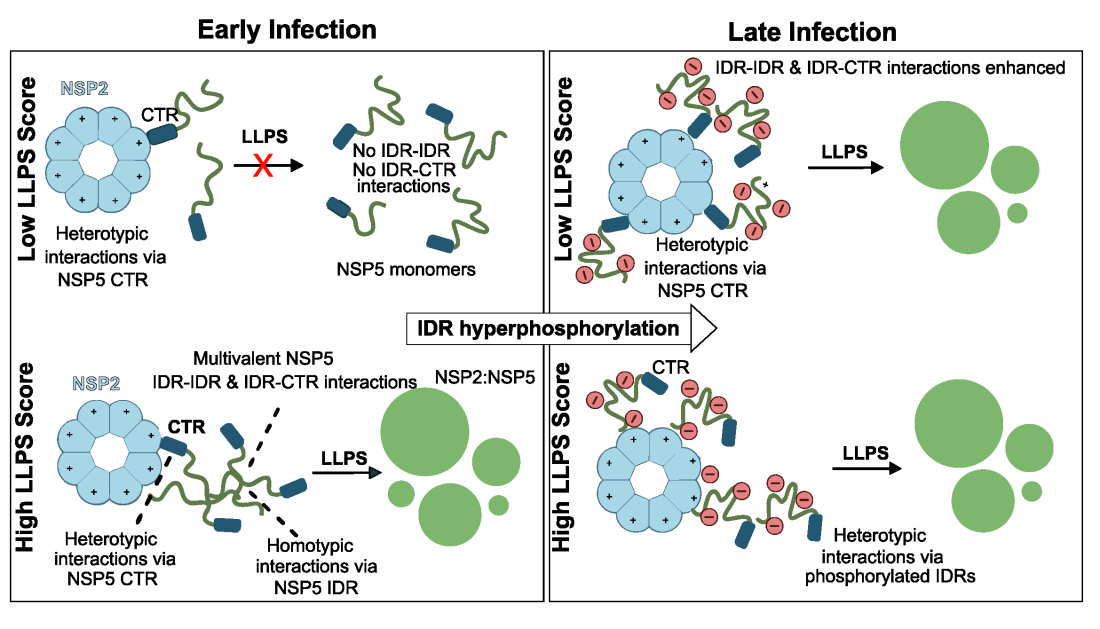 Phosphorylation tunes protein condensation and interactions during rotavirus replication organelle assembly.
Written by Zara Kaplan (Freeman Lab)
Explore more
Read the paper
Acker, J., Wang, X., Pardal, A. J., et al: Phosphorylation tunes strain-specific protein condensation during rotavirus replication organelle assembly. EMBO J Volume 45, pages 4733–4765 (2026)
Borodavka Group
We use fluorescent molecules, biochemistry, and biophysics to dissect the regulatory roles of RNAs in virus assembly and infection.
Infection and Immunity
Several Dunn School groups use a range of approaches to investigate antigen presentation and immune regulation during health and disease and study the mechanisms that enable bacterial and viral pathogens to invade and proliferate inside their hosts.