New ‘molecular glue’ helps break down antibiotic resistance enzymes in E. coli
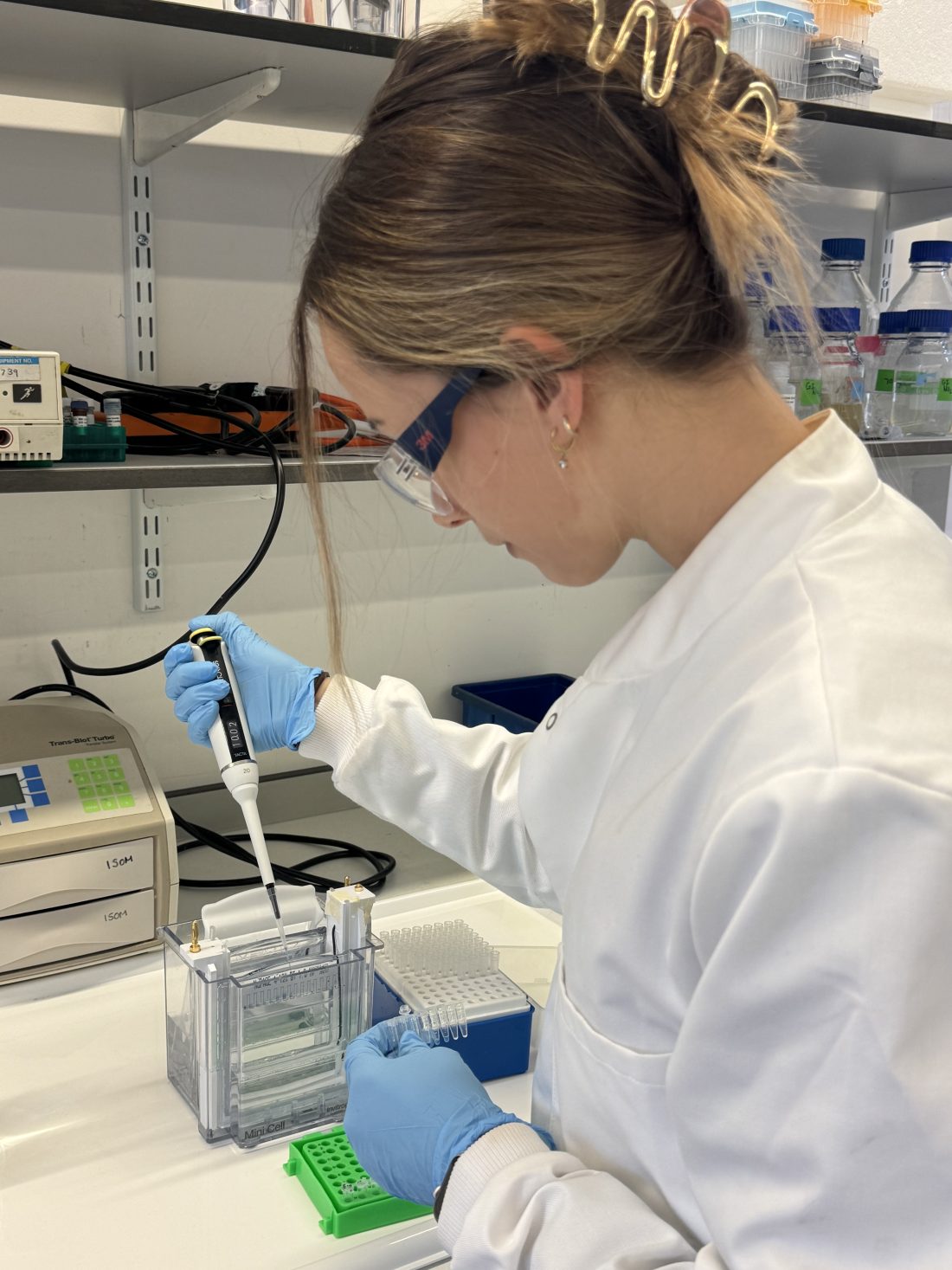
Gemma Marshall, who is now working on this project, in the lab
Since the first successful isolation and administration of penicillin by scientists here in Dunn School during World War II, antibiotics have become one of the most used drugs to treat and prevent infections. However, due to AMR, one in six bacterial infections are now resistant to antibiotic treatments. Developing entirely new antibiotic classes remains highly challenging, creating an urgent need for alternative approaches that can preserve the effectiveness of existing treatments.
β-lactam antibiotics, a family of drugs that includes penicillin, are among the most widely used antibiotics in the world. One of the most common ways bacteria resist β-lactam antibiotics is by producing enzymes called β-lactamases, which destroy these drugs before they can treat infections. Originally identified in the Dunn School by Chain and Abraham in 1940, β-Lactamases enzymes are particularly widespread, with over 2,000 variants identified to date.
Existing approaches to combat β-lactamase enzymes aim to block their action by delivering additional drugs, known as ‘antibiotic adjuvants’, alongside the antibiotic treatment. The new approach conceived by the Isom group together with the team of Thomas Lanyon-Hogg in the Department of Pharmacology, and led by PhD student Emilia Taylor, proposes a novel way to tackle this issue. The new approach, called targeted protein degradation, exploits naturally occurring bacterial proteases, by redirecting them towards β-lactamase enzymes.
The team started by looking at a specific protease called DegP. In lab tests, they found that the naturally occurring protease DegP could break down certain types of β-lactamase enzymes, the TEM-family of β-lactamases.
They then screened a range of antibiotic adjuvant drugs, finding that one existing β-lactamase inhibitor, tazobactam, caused a small increase in the speed at which DegP broke down TEM β-lactamases. They determined that tazobactam is reacting with the active site of the β-lactamase – the key region of the enzyme where biochemical reactions occur – to cause a change in the shape of the β-lactamase, making it more susceptible for DegP to break down.
Next, the researchers investigated which other proteins DegP could degrade in E. coli, allowing them to identify specific sequences of amino acids that were more commonly found in bacterial proteins that were degraded by DegP.
By chemically linking these specific amino acid sequences to tazobactam, the researchers were able to produce a ‘molecular glue’ called OXF-232, which greatly enhanced the speed at which DegP broke down the β-lactamase resistance enzyme in laboratory experiments.
The scientists then tested OXF-232 against a resistant E. coli strain, which produced high quantities of the β-lactamase enzyme. The OXF-232 was administered in combination with the β-lactam antibiotic piperacillin, and the study demonstrated not only that OXF-232 enhanced the antibiotic’s effects, but that when combined with high concentrations of piperacillin it even outperformed the clinically-used drug tazobactam.
Emilia Taylor, DPhil student in the Sir William Dunn School of Pathology and the Department of Pharmacology at the University of Oxford, and lead author of the paper, said, “We were surprised to find that tazobactam, a drug used clinically in combination with β-lactam antibiotics, showed this effect in accelerating degradation by DegP. Improving our understanding of the types of proteins that DegP can break down allowed us to rationally design more effective molecular glues to degrade β-lactamase resistance enzymes.”
With this work, the teams demonstrated that new ‘molecular glue’ compounds can effectively bring together the protease and β-lactamase enzymes, enhancing the breakdown of β-lactamases and protecting some of our most important antibiotics. This opens the possibility for restoring the effectiveness of existing antibiotics in the fight against antimicrobial resistance.
Read the paper
Emilia K. Taylor, Patricia Santos Barbosa, Tarini Kadambi, Frederik Eisele, Yiqiao Wang, Elisabete C. C. M. Moura, Timothy R. Walsh, Georgia L. Isom, Thomas Lanyon-Hogg (2026) Molecular Glue Degraders of TEM β-Lactamases by Periplasmic Protease DegP, Angewandte Chemie International Edition
Isom lab
The Isom lab use a combination of structural biology, biochemistry and bacterial genetics to study Gram-negative bacterial membrane transport systems.
Infection & Immunity
Several Dunn School groups use a range of approaches to investigate antigen presentation and immune regulation during health and disease and study the mechanisms that enable bacterial and viral pathogens to invade and proliferate inside their hosts.