Rewiring T cell co-receptors to improve the safety of cancer immunotherapy
Published in Nature Biomedical Engineering, the work shows that T cell cross-reactivity can be finely controlled by engineering co-signalling receptors, offering a universal way to make adoptive T cell therapies safer without altering the T cell receptor (TCR) itself.
Adoptive T cell therapy, in which patient T cells are engineered to express tumour-specific TCRs, has shown remarkable promise in cancer treatment. However, a major limitation of this approach is TCR cross-reactivity: engineered T cells can mistakenly recognise healthy tissues, leading to severe and sometimes fatal autoimmune toxicities. Current strategies to mitigate this risk largely focus on painstakingly identifying TCRs with intrinsically low off-target activity, a process that is time-consuming and not always reliable.
In this study, Cabezas-Caballero and colleagues take a fundamentally different approach. Instead of modifying the TCR, they investigate whether T cell cross-reactivity can be tuned through co-signalling molecules that modulate TCR signalling strength. Focussing on CD5, CD8 and CD4, the authors systematically dissect how these receptors influence antigen sensitivity and specificity.
A central finding from this work is that co-receptors CD8 and CD4 have opposing effects on ligand discrimination. CD8 lowers the activation threshold for low-affinity peptides, thereby reducing discrimination, whereas CD4, when expressed in a context where it cannot engage its canonical ligand, increases discrimination. By knocking out CD8 in cytotoxic T cells and expressing CD4 in its place, the authors implement a co-receptor switch that substantially raises the activation threshold for lower-affinity, off-target peptides. Importantly, these engineered T cells retain strong on-target responses against their intended tumour antigens, maintaining cytotoxic potency while becoming far more selective.
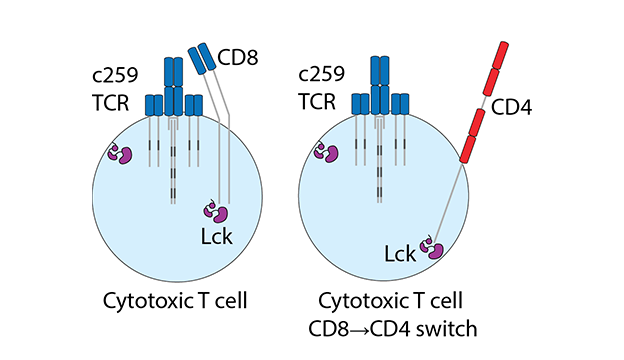
Schematic of CD8→CD4 co-receptor switch in cytotoxic T cells
By decoupling TCR specificity from co-receptor-mediated signal amplification, the authors show that it is possible to generate ‘super-selective’ T cells that are much less likely to trigger harmful autoimmune reactions. Because this strategy does not depend on altering the TCR sequence itself, it could, in principle, be applied broadly across many different TCR-based therapies.
Overall, this work highlights co-receptor engineering as a powerful and generalisable tool to enhance the safety of T cell immunotherapies. By reducing the risk of lethal off-target cross-reactivity while preserving anti-tumour efficacy, the study opens new avenues for the clinical development of safer, more reliable TCR-T cell treatments.
Written by Zara Kaplan (Freeman lab)
Read the Paper
Cabezas-Caballero, J., Huhn, A., Kutuzov, M.A. et al. Generation of T cells with reduced off-target cross-reactivities by engineering co-signalling receptors. Nat. Biomed. Eng. (2026). https://doi.org/10.1038/s41551-025-01563-w
Dushek lab
Understanding how the immune system discriminates between normal and abnormal tissues, and harnessing this knowledge to develop new therapies
van der Merwe lab
Investigating the mechanisms by which leukocytes use cell surface receptors to recognise infected or otherwise abnormal cells