More than just a food fight: what it takes to succeed in a bacterial community
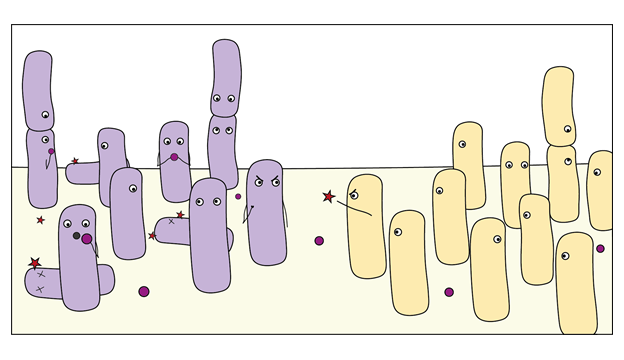
The human body is a battleground for bugs. Across multiple fronts – from fuzzy teeth to the depths of our digestive systems – bacteria are waging an invisible war for the resources available. Aggressive strategies or ‘interference’ targeted at competing strains can manifest in different ways; from the use of ranged weapons like released toxins to melee attacks with the spear-like type six secretion system (T6SS). Whether producing these weapons is worth the cost for bacteria is a key question in antimicrobial resistance) research, where work is ongoing to engineer beneficial strains capable of outcompeting and displacing problematic residents.
The mathematical model developed by the team predicts that tools like the TS66 are actually fairly useless for rare invaders. Success against overwhelming forces is instead determined by the ability to secure resources – especially ‘private nutrients’, which invaders enjoy but existing residents find unpalatable. Invaders must then survive any deadly interference in their new neighbourhood long enough for growth to outpace mortality. With enough time and eventual rearmament, invading underdogs can even launch their own campaign of toxic interference and displace the resident strain.
These predictions played out across several experimental scenarios using both engineered E. coli and naturally occurring isolates with antimicrobial resistance. While antimicrobial resistance strains are metabolically diverse, a predicted nutrient niche difference to the resident strain was the consistent factor for successful invasion. Invaders able to gain a foothold and with the capacity to ramp up effective interference measures were also able to displace residents. Tellingly, these same resident-invader pairs behave very differently when their battle plays out in a neighbourhood of diverse communities; invasion is effectively blocked in the face of wide competition for what might otherwise be private nutrients.
This work builds on previous studies that suggest successful niche invasion ultimately comes down to obtaining the right nutrients. However, once strains are established antimicrobial weapons can be used to devastating effect. These deceptively simple rules of engagement are of fundamental importance to researchers investigating complex questions around the gut microbiome and antimicrobial resistance, where effective biotherapeutic strains and tailored supplementation could be a powerful tool for ousting problematic bacteria.
Read the paper here: Bakkeren, E., Piskovsky, V., Lee, M.N.Y. et al. Strain displacement in microbiomes via ecological competition. Nat Microbiol (2025). https://doi.org/10.1038/s41564-025-02162-w
Written and illustrated by Charlotte Melia (Electron Microscopy Facility)
Explore more
Read the Paper
Bakkeren, E., Piskovsky, V., Lee, M.N.Y. et al. Strain displacement in microbiomes via ecological competition. Nat Microbiol (2025). https://doi.org/10.1038/s41564-025-02162-w
Foster Group
The Foster group seek to understand and manipulate microbial communities by combining ecological and evolutionary approaches with the study of the human gut microbiome.
More news
The latest news stories and research highlights from the Dunn School.